Sacramento · Yolo · Placer
Character Homes in Sacramento: The Complete Guide
A character home is one whose design still tells you when and how it was built: a Midtown Victorian, a Curtis Park bungalow, a Land Park Tudor, an Eichler in South Land Park Hills or a Streng post-and-beam in Wilhaggin. This guide walks through each kind, where it sits in the region, and what to know before you buy one or sell one.
Written by Rachel Dee Minyard, REALTOR® and Creative Director, November 2026. CA DRE #02213398.
A note from Rachel
“Not every home was meant to look like every other home.”
Some people walk into a house and count bedrooms. Others notice the built-in buffet, the glass wall to the garden, the arched doorway nobody would build today. If you are the second kind, this guide is for the way you look at houses.
Sacramento has an unusual range of them. Victorians on Midtown's lettered streets. Bungalows in Oak Park, Curtis Park and Old North Davis. Storybook cottages around William Land Park. Eichlers and Streng homes with walls of glass. Each one asks for a slightly different eye, whether you are buying it or letting it go.
I wrote this so you can see the whole picture in one place. Each part gives you the short version, then links to the full articles and neighborhood guides. Read the part you need today. Come back for the rest.
Rachel
Most people start with these
- Is a Carmichael Mid-Century Home a Money Pit?Read the article →
- What Does a Walkable Character Neighborhood Look Like Day to Day in Sacramento?Read the article →
- How Do You See the Potential in a Midtown Sacramento Bungalow?Read the article →
- How Do You Sell a Mid-Century Modern House So Buyers See the Design?Read the article →
- What Should You Do Before Selling a Curtis Park Home With Original Details?Read the article →
- Mid-Century Modern Homes in SacramentoRead the guide →
The whole guide
- 01What makes a home a character home, and will it feel like me?
- 02What should I know about a Victorian on Midtown's grid?
- 03Is a Sacramento bungalow worth a second look?
- 04What comes with a Land Park Tudor or an East Sacramento revival home?
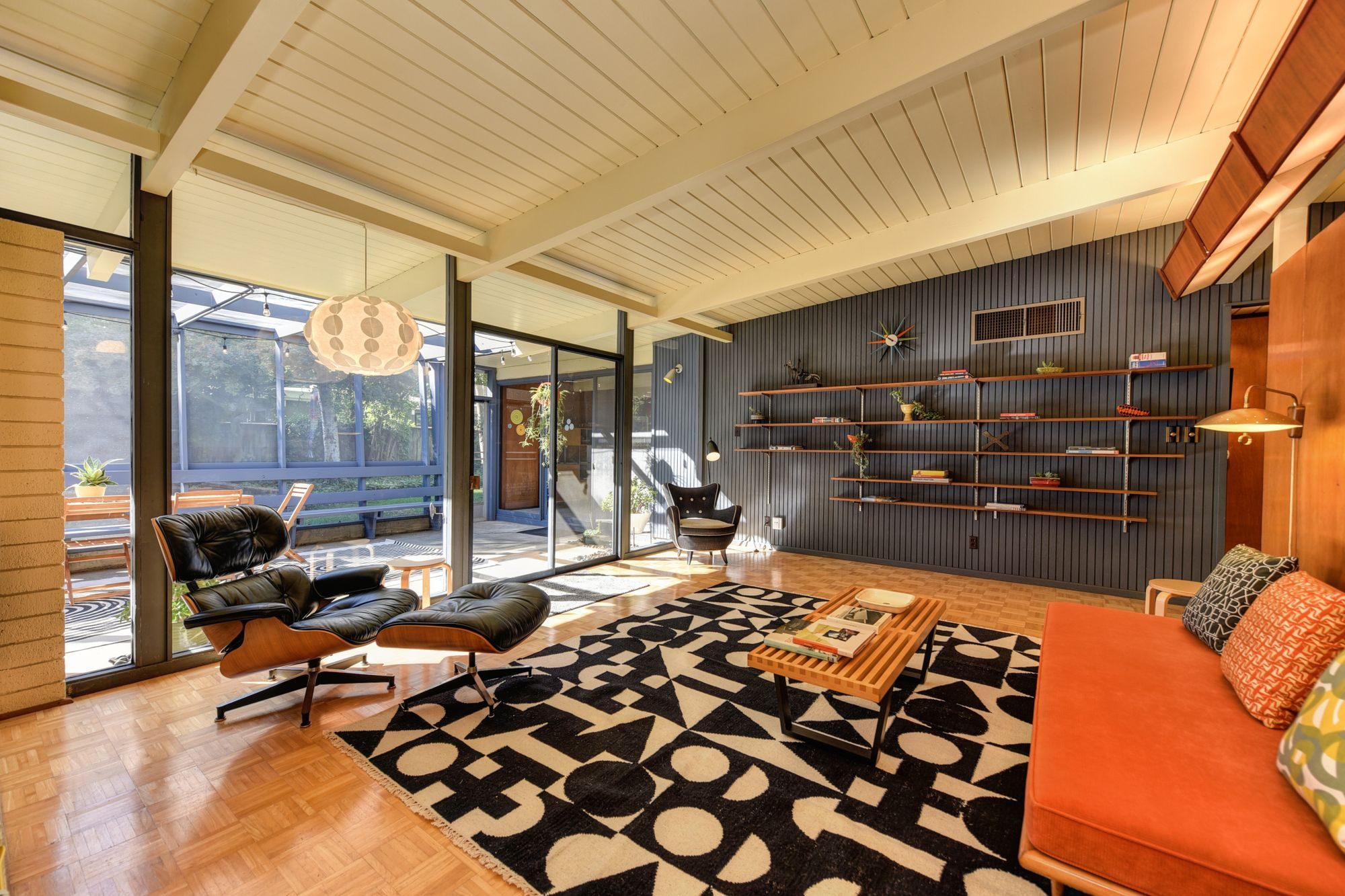
- 05Where are Sacramento's Eichlers and Streng Brothers homes?
- 06Is a 1950s house worth buying in Sacramento?
- 07Where else can I find an older home with a story?
- 08Can I change the windows on a house in a historic district?
- 09Is a character home a money pit?
- 10Will buyers see what makes my house special?
- ?Questions people ask about character homes
Part 1 · What it means
What makes a home a character home, and will it feel like me?
It is not only age. A character home still carries the choices its builder made: the materials, the proportions, the way the rooms meet the street and the yard.
Plenty of houses are old. A character home is one where the original thinking still shows. The porch that was built for sitting. The plaster coves in a 1930s living room. The post-and-beam frame that lets a wall of glass carry the garden into the kitchen. You can usually name the decade from the curb, and often the builder.
What matters is whether those details are still there, and whether they still work. A 1927 house with its original windows, trim and floors reads very differently from the same house after three remodels in three different decades. Neither is wrong. They are simply different houses, and they are priced, inspected and marketed differently.
That is the thread through this whole guide. I try to help people see past the cover of a home to the bones and the potential, and to be honest about what those bones need. A character home rewards a buyer who knows what to look for, and a seller who knows what to leave alone.
If you want to start with a feel for the life around these houses, read what a walkable character neighborhood looks like on an ordinary Saturday and an ordinary Tuesday.
Part 2 · Victorians
What should I know about a Victorian on Midtown's grid?
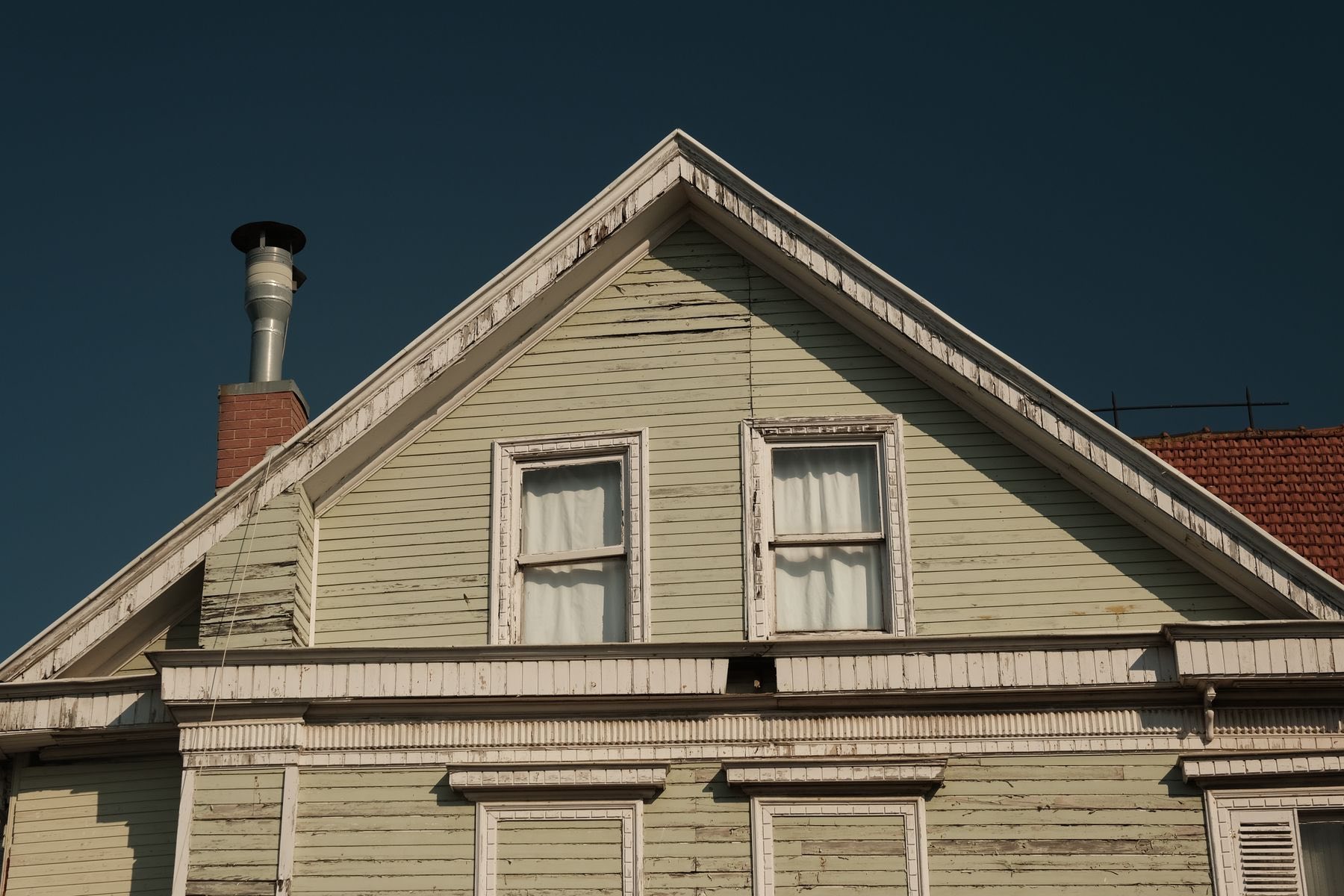
Midtown has many of the city's Victorians, on numbered and lettered streets east of downtown, with newer lofts and apartments between them. Several pockets are city historic districts.
Midtown is the tree-lined street grid east of downtown, and Victorian houses went up along its residential streets, and many still stand on the numbered and lettered blocks. Lots are small, and many houses sit close to the sidewalk.
Some Victorians are still single-family homes. Others were divided into flats years ago, so the same facade can hide one household or three. That changes everything about the purchase: the loan, the inspection, and whether there are tenants with rights of their own under the City of Sacramento's tenant protection program.
The city protected several pockets as historic districts, including Boulevard Park, Newton Booth and Poverty Ridge. Inside them, exterior work such as new windows, siding, doors or a porch usually needs city preservation review before a permit. That is not a reason to avoid them. It is a reason to know before you write an offer, so your plans and the city's rules line up.
Daily life here is on foot. The Second Saturday art walk fills the galleries and sidewalks once a month, and Sutter's Fort, a state historic park at 2701 L Street, sits a few blocks from many front doors.
Part 3 · Bungalows
Is a Sacramento bungalow worth a second look?
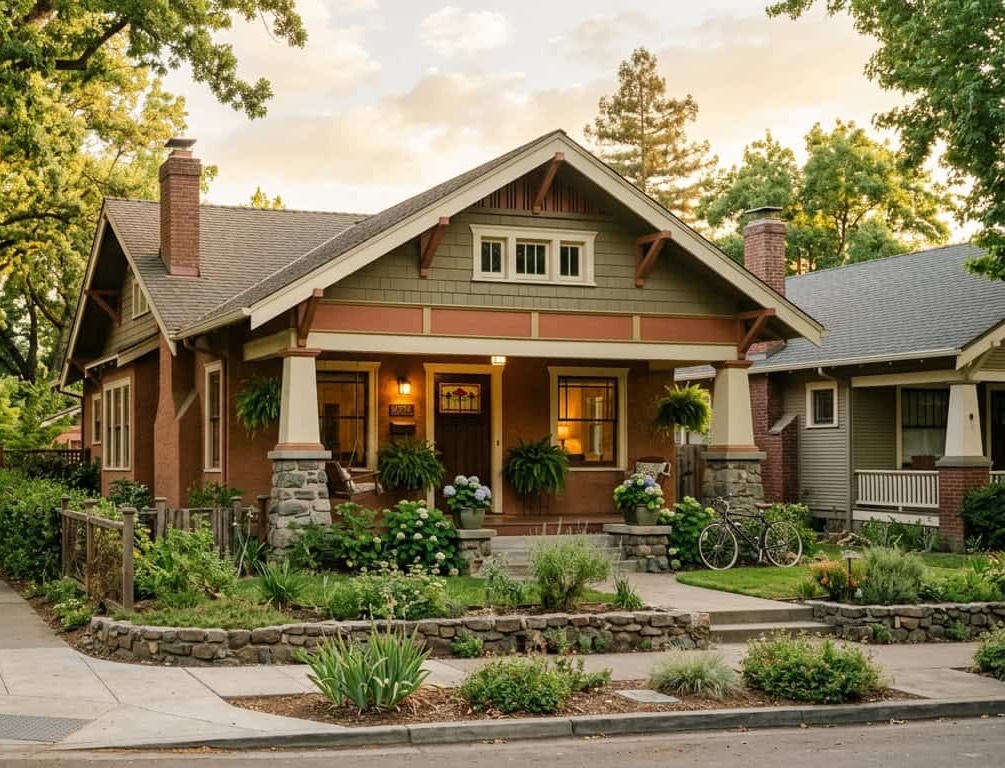
Bungalows are the backbone of Sacramento's older neighborhoods: Bungalow Row in Midtown, Curtis Park, Oak Park, Elmhurst and, across the causeway, Old North Davis.
Midtown's Bungalow Row district covers homes built from 1900 to 1915 along Q, 25th and 26th Streets. Curtis Park, between Freeport Boulevard and Highway 99, mixes Victorian, bungalow and 1920s revival homes a short walk from William Land Park. Oak Park, laid out in 1887 around an oak grove as Sacramento's first suburb, has early bungalows with newer infill mixed in since 2010.
Elmhurst began as a 1908 subdivision south of U.S. 50 along T Street. Its homes are often described as 1920s bungalows and Spanish Revival houses, and some of the older bungalows have been expanded, a few of them into two stories. Sunset Park and Sierra Vista Park still run down the middle of the old California Boulevard, as they have since the subdivision was laid out.
In Davis, Old North Davis grew from the Bowers Addition of 1913. A neighborhood count puts about 140 homes there from before 1950: roughly 50 bungalows from the 1910s and 1920s, and roughly 90 cottages from the 1930s and 1940s.
What these streets share is variety on a single block. A renovated bungalow, an original one and a new house can sit side by side, which is why prices in a place like Oak Park move more from block to block than in most of the city. When you look at a bungalow, you are really asking two questions. What is original and worth keeping? And what is tired, small or simply not working anymore?
Part 4 · Tudors and revivals
What comes with a Land Park Tudor or an East Sacramento revival home?
Land Park and East Sacramento hold much of the city's prewar housing, with Tudor Revival homes and storybook cottages, and Sierra Oaks adds Normandy-style houses from 1929 on.
Most of Land Park's houses were built in the 1930s, wrapped around William Land Park between I-5 and Freeport Boulevard. Tudor Revival homes and storybook cottages are the styles people point to, and the names behind many of them are local designers such as Arthur Widdowson, Dean and Dean, and Frank "Squeaky" Williams.
East Sacramento is mostly prewar and midcentury single-family homes east of Midtown, from the large lots of the Fabulous Forties to smaller blocks around McKinley Park. The park's rose garden was established in 1928 by Frederick Evans, Sacramento's first parks superintendent. Every December the Forties turn into one of the city's best-known holiday lights drives.
Farther out, Sierra Oaks goes back to 1929, and most of its earliest houses were built in the Normandy style. Next door, Arden Park Vista was recorded in 1945 and built in units by Wright and Kimbrough, whose 1950 ads promised architectural controls.
These houses tend to have plaster walls, steep rooflines, small original kitchens and baths, and wiring and plumbing that may or may not have been updated. A good inspection matters as much as a good eye. So does knowing which updates a buyer here will thank you for, and which ones they will quietly price against.
Part 5 · Mid-century
Where are Sacramento's Eichlers and Streng Brothers homes?
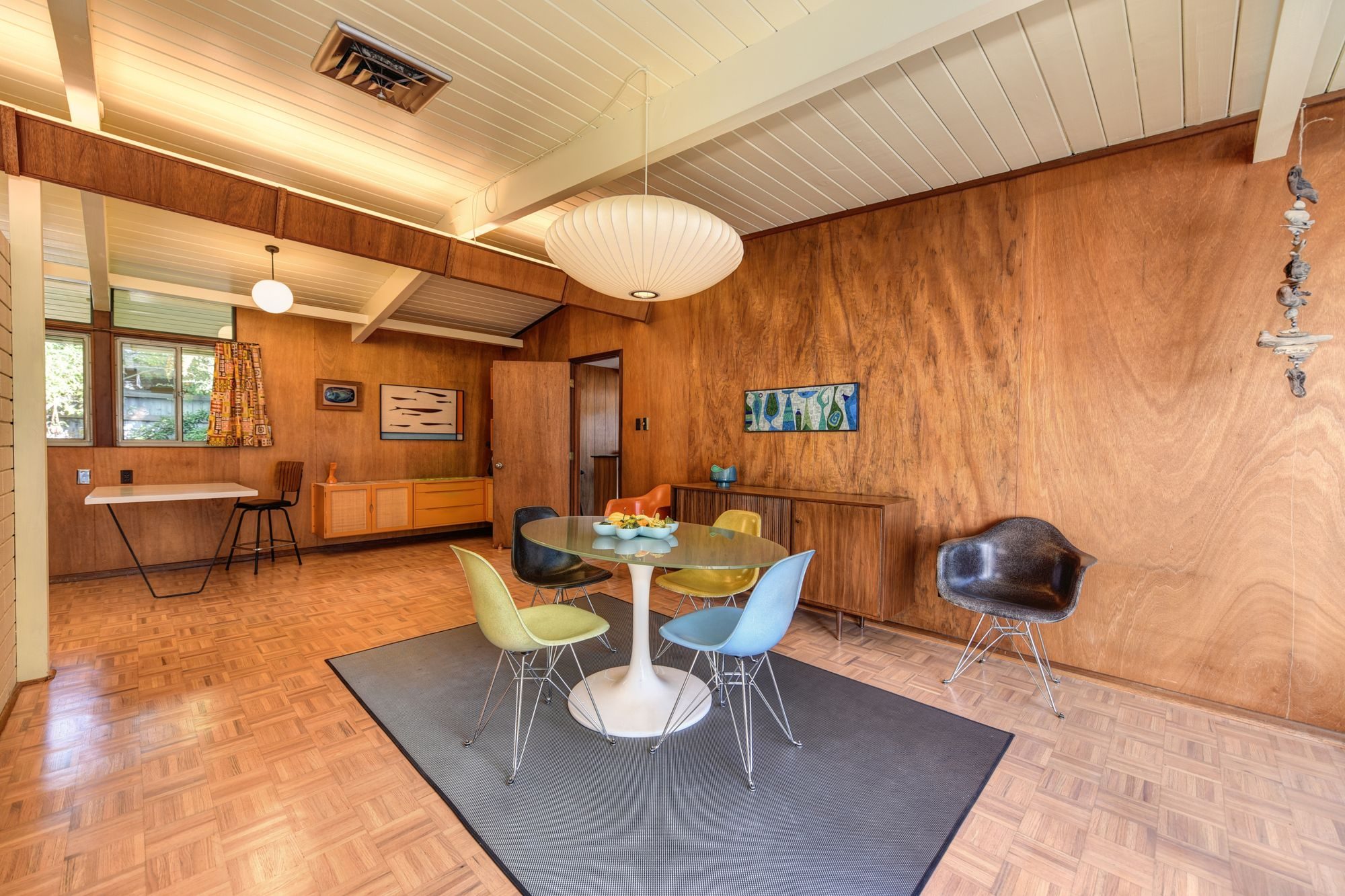
Sacramento has one named Eichler district, in South Land Park Hills, and a long run of Streng Brothers homes, including about 150 in Wilhaggin. Glass walls, open plans and flat or low-pitched roofs.
If you want an Eichler, South Land Park Hills is the place to look. Joseph Eichler built homes there in 1955 and 1956, centered on South Land Park Drive, Fordham Way and Oakridge Way, and the city made it the South Land Park Hills Eichler Historic District on May 21, 2024. Exterior changes there, such as windows, siding or rooflines, usually need city preservation review before a building permit.
The Streng Brothers were Sacramento's own mid-century builders. In Wilhaggin, along the American River, they built about 150 post-and-beam homes between 1968 and 1972, every one designed by architect Carter Sparks. Strengs show up in many other tracts across the region, and our mid-century page lists the ones the sources name, street by street.
Arden-Arcade has its own mid-century layer. It grew from about 1947 to 1960, on wide lots, and mid-century buildings from 1961 to 1963 still stand along El Camino and Watt Avenues, including Country Club Plaza, designed by architect Charles Luckman. In Davis, Village Homes began in 1975 around passive solar homes, shared orchards and rainwater swales instead of storm drains, and was finished in 1982.
These homes ask different questions. Low-pitched roofs, big runs of glass, skylights and original paneling each deserve an inspector who has seen them before. An Eichler is priced from other Eichlers, not from the ranch house down the street. And selling one well means showing the design, not apologizing for it.
Read more on this
- Is a Carmichael Mid-Century Home a Money Pit?
- How Do You Sell a Mid-Century Modern House So Buyers See the Design?
- Mid-Century Modern Homes in Sacramento
- South Land Park neighborhood guide
- Sierra Oaks and Arden Park neighborhood guide (Wilhaggin)
- Arden-Arcade neighborhood guide
- Village Homes neighborhood guide
Part 6 · Post-war streets
Is a 1950s house worth buying in Sacramento?
Hollywood Park, Tahoe Park and River Park were built fast after the war. Their single-story homes share bones from the same few years, which makes them easier to read once you know one.
Hollywood Park is a post-war neighborhood of about 600 homes between Freeport Boulevard and 24th Street. In 1950 the Sacramento Union called it one of the fastest-growing sections of the post-war building boom. It is mostly single-story bungalows and ramblers on smaller lots, a few minutes from William Land Park and Sacramento City College.
Tahoe Park sits south of U.S. 50 around a 19-acre city park near Sac State. Tahoe Terrace, platted in 1945, holds the classic post-war tract homes, and the later annexations to the east and south add more. River Park sits inside a bend of the American River, where Orchard Terrace Unit One went on sale in 1947 and Unit Two in 1948. The H Street truss bridge, built in 1932, still crosses the river there.
These are the houses people sometimes overlook on the way to something fancier. Look again. A single-story layout, a real yard and a straightforward frame are what many buyers are looking for, and a post-war house often takes a thoughtful update well.
Part 7 · Old towns
Where else can I find an older home with a story?
Character is not only in the central city. Old Town Elk Grove, downtown Lincoln, Fair Oaks Village and the Carmichael Colony all hold older homes on streets with their own history.
Old Town Elk Grove is the original railroad-era main street on Elk Grove Boulevard. Homes from 1868 to 1892 lean toward vernacular and late Victorian designs, and homes from 1893 to 1926 move toward plainer Craftsman styles. More than 40 buildings there form a historic district on the National Register of Historic Places, so find out early whether a house you love is on a register.
Downtown Lincoln is the city's original 1859 town grid along the railroad, with its oldest homes and McBean Park close by. The Gladding, McBean plant at the edge of downtown still makes architectural terra cotta.
Two county overlays cover Fair Oaks Village. The 1979 Fair Oaks Village Special Planning Area governs the commercial core, regulates signs and grading so new work fits the Village, and does not require any one architectural style. The 2006 Neighborhood Preservation Area covers 94 nearby residential parcels, with lot size, lot coverage and height limits. In Carmichael, Daniel Carmichael sold the first 10-acre tracts of the Carmichael Colony in 1909. Many were later split into home lots, so one street can hold a ranch house on a small lot next to a much larger parcel. The Carmichael Creek preservation area along the river holds about 1,000 more homes.
Out here, character often means the lot and the street as much as the house. The question to ask is the same one I ask in Midtown: what is this place protecting, and does that fit the way you want to live?
Part 8 · Historic rules
Can I change the windows on a house in a historic district?
A historic district usually means city or county review before exterior changes. It shapes what you can change, how long it takes, and how a home is priced, so it belongs in the plan from day one.
The City of Sacramento keeps a register of about 30 historic districts. In Midtown that includes Boulevard Park, Newton Booth and Poverty Ridge. Oak Park has a city-adopted district on Broadway between 33rd and 36th Streets. South Land Park Hills became an Eichler historic district in 2024. Outside the city, Sacramento County draws its own preservation areas, such as Carmichael Colony, Carmichael Creek and the 94 residential parcels of the Fair Oaks Village Neighborhood Preservation Area.
Inside a city district, exterior work such as windows, doors, siding, porches or rooflines usually needs preservation review before a building permit. Interiors are generally your own business. Preservation areas in the county work differently, and the county's Land Use Regulation Library shows whether a parcel sits inside one.
For a buyer, the practical step is to check the address before the contract deadlines, and to build any exterior plans around the review. For a seller, being inside a district is part of the story of the house, and buyers who want these streets usually already know it. Either way, the city or county confirms the rules for a specific address. I can help you ask the right questions; the answers come from them.
Part 9 · Buying one
Is a character home a money pit?
Fall for the house, then ask the questions. Separate what is cosmetic from what is structural, read the systems, and know which details you would never change.
The best part of a character home is often the first thing you see. The hardest part is usually behind the walls. Wiring and sewer lines in a house built in 1929 or 1955 deserve a real look, and in older areas like Sierra Oaks and Arden Park, their age is one of the first things worth checking.
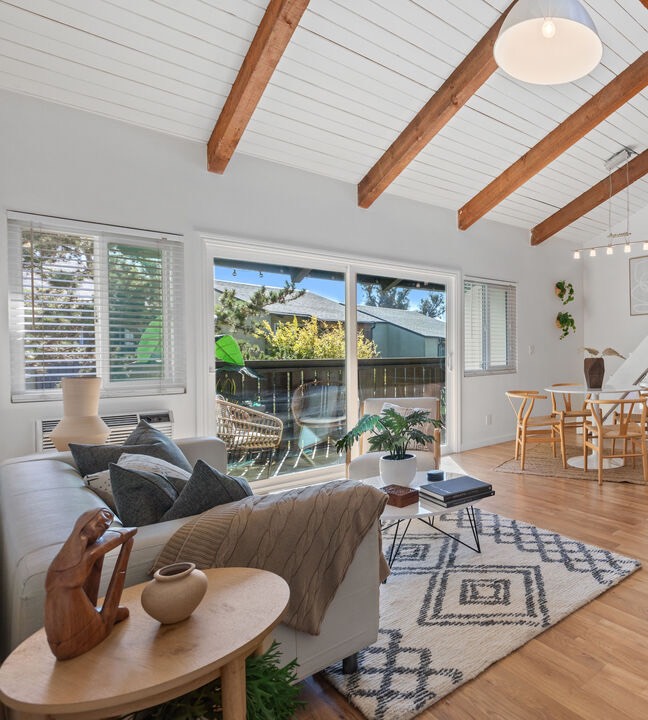
It helps to walk an older home in three passes. First, what is cosmetic: paint, fixtures, a dated light, a tired floor that refinishes. Second, what is structural or mechanical: the roof, the foundation, the panel, the plumbing, the sewer lateral, the windows. Third, what is irreplaceable: the trim, the built-ins, the tile, the beams. That last list is usually why you are there. Protect it in the plan.
Then get the right inspections, from people who have seen this kind of house before, and read every report before your contingency dates. A mid-century flat roof, a Victorian's foundation and a 1930s plaster wall each have their own specialists. A home that asks for work is not a mistake. A home you did not understand before you bought it can be.
Part 10 · Selling one
Will buyers see what makes my house special?
A home with history does not need an apology. The work is deciding what to refresh, what to protect, and how to tell its story so the right buyer recognizes it.
Sellers of older homes often assume they have to remodel first. Sometimes a refresh pays for itself. Often the better move is smaller: repair what an inspector will flag, clean and light what is original, and leave the big choices to a buyer who will want to make them their way.
An original kitchen is the classic example. A remodel chosen to please everyone can erase the very thing a buyer of an older home came to see. The kitchen you have is a fact of the house. How you present it is a choice.
Then the story. A character home should not be marketed like the house down the street. That means photography that leads with the right room, words that name the builder, the decade and the details without a lecture, and pricing built from homes like it, not just homes near it. For an Eichler or a Streng, that can mean looking across several tracts to find a fair comparison.
If you are torn about selling at all, that belongs in the plan too. Leaving a street you love is a real decision, and it deserves a real conversation before anyone talks about list prices.
Read more on this
A home with character deserves representation with vision.
Buying one, selling one, or still deciding? Tell me the street, and what you love about the house. I'll walk it with you and tell you what I see, at your pace.
Questions people ask
Frequently asked questions about character homes
Is a mid-century home a money pit?
Not by itself. Separate what is cosmetic from what is structural or mechanical, get inspections from people who know that kind of house, and read the reports before your contingency dates. Low-pitched roofs, big runs of glass and original systems each deserve a specialist's look. The cost depends on that one house.
Where are the Streng Brothers homes in Sacramento?
In many tracts across the region. In Wilhaggin, along the American River, Streng Brothers built about 150 post-and-beam homes between 1968 and 1972, every one designed by architect Carter Sparks. Our mid-century page lists the tracts the sources name, area by area.
Where are the Eichler homes in Sacramento?
In South Land Park Hills, around South Land Park Drive, Fordham Way and Oakridge Way. Joseph Eichler built them in 1955 and 1956, and the city made the area a historic district on May 21, 2024.
Is a 1950s house worth buying in Sacramento?
It can be, once you know its systems. Post-war neighborhoods such as Hollywood Park, Tahoe Park and Arden-Arcade were built in short bursts, so many houses share bones from the same few years. Check the roof, electrical panel, plumbing and sewer line before you commit.
Can I change the windows on a house in a Sacramento historic district?
Usually only after city preservation review, which applies to exterior work such as windows, doors, siding, porches and rooflines in districts like Boulevard Park, Newton Booth and the South Land Park Hills Eichler district. Check the address with the city before you plan the work.
Should I renovate before selling or sell as is?
Often neither extreme. Many sellers of older homes do well repairing what an inspector will flag, cleaning and lighting what is original, and leaving big remodels to the buyer. A walk-through before you call a contractor shows which updates are likely to matter for your house.
If I sell my older home and regret it, can I undo it?
You can sometimes buy back into the same neighborhood, but not the same house. Test the decision before you list: name what you would miss, walk the streets you might move to, and give yourself time. There is no deadline on the conversation.
Homes hold stories. The right buyer is usually the one who can read them.
Rachel Dee Minyard, Surroundings Real Estate & Lending
General information about older and historic homes in the Sacramento region. Historic district and preservation rules are set by the city or county for each address; please confirm them, and have every home inspected by qualified professionals.